Step Flashing and Counter-Flashing Are Not Optional Halves.
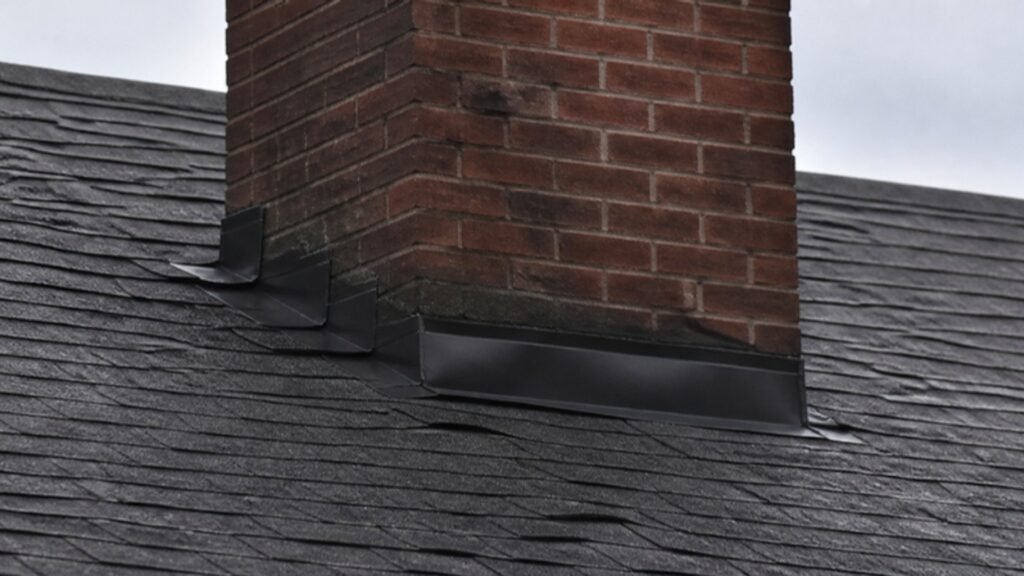
Chimney flashing is a two-part system and understanding that explains most of what goes wrong with it. Step flashing is a series of L-shaped pieces woven into the shingle courses as the roof is laid, so each one laps the one below. Counter-flashing is a separate piece let into a cut groove in the mortar joint, bent down over the step flashing. The roof can move, the masonry can move, and the joint stays closed because the two halves overlap rather than being bonded to each other.
What we find instead, over and over, is a single piece of metal run up the brick and held there with a heavy bead of sealant or roof cement. That works for a few seasons. Then the sealant shrinks, cracks and lets go – it is a consumable, not a flashing – and the chimney leaks again. The same goes for flashing nailed face-on into the brick, which puts fasteners through the water barrier, and for flashing reused from the old roof when the roof was replaced.
There is also the matter of what is above the chimney. On a wide stack set low on a slope, snow and water run down the roof and pile against the uphill face. That is what a cricket is for: a small framed saddle behind the chimney that splits the flow around it. A chimney wide enough to need one and not have one will keep failing at the uphill flashing whatever metal you put there.
How We Work
How We Flash a Chimney
Cut into the masonry, woven into the roof, and no sealant doing structural work.
Full system inspection
We establish what is actually there - counter-flashing let into a joint or a bead of sealant against the brick - check the shingle courses around it, and assess whether the stack is wide enough to need a cricket.
01
Define the Scope
You get the flashing specified in both halves, the cricket called out if the chimney needs one, and any mortar joint work the counter-flashing cut requires stated up front.
02
Execute the Repair
New step flashing woven into the shingle courses, counter-flashing cut into the mortar joint and set, a cricket framed and flashed where the chimney calls for it, and the roof made good around all of it.
03
Verify & Document
We water-test the finished junction, confirm nothing is relying on sealant to stay watertight, and photograph the cut, the metal and the completed detail.
04
Our Projects
Real WORK. REAL Results.
See how we’ve helped homeowners across Seattle and surrounding areas solve chimney, roofing, and masonry problems with clear scopes and lasting repairs.
Freestanding Gas Fireplace Installation in Mercer Island, WA
Mercer Island, WA
Why Chimneyz
The Cut Belongs to the Mason
Counter-flashing has to be let into the mortar joint, which means cutting a groove in the masonry and pointing it back in. Roofers understandably do not want to cut a customer’s brickwork, so they seal to the face instead and it fails. We are masons as well as roofers, so the groove gets cut properly and the chimney gets repointed in the same visit.
GAF Certified Contractor
Factory-certified roofing installer with access to enhanced warranty coverage and proven materials.
BBB Accredited
Better Business Bureau accreditation with a commitment to ethical practices and customer satisfaction.
READY TO SOLVE THE FULL PROBLEM?
Get a Clear Inspection and the Right Repair Plan.
From chimney leaks and failing masonry to roofline issues and interior damage, Chimneyz helps homeowners identify the real source of the problem and fix it with one coordinated solution.
See how Chimneyz solves complex chimney, roofline, masonry, and restoration issues with clear scopes and high-quality execution.
FAQ
Chimney Flashing FAQ
Flashing is where the roof and the masonry meet, which is exactly why it gets done badly.
What exactly is chimney flashing?
Two separate pieces of metal. Step flashing woven into the shingles, and counter-flashing set into a cut groove in the mortar and folded down over it. Together they close the joint without bonding the roof to the chimney.
Why did my flashing repair fail so quickly?
Because it was almost certainly sealant doing the job of metal. Roof cement against brick shrinks and cracks within a few seasons. Flashing that is cut into the masonry does not depend on anything staying flexible.
Do I need a chimney cricket?
If the chimney is wide and sits below the ridge, yes. Without one, water and debris pile against the uphill face and sit there. A cricket splits the flow around the stack instead of into it.
Can flashing be replaced without redoing the roof?
Yes. We lift and reweave the courses immediately around the chimney and make the roof good. A full re-roof is only the right moment if the roof is near the end anyway.
Should flashing be replaced when the roof is replaced?
Always. Reused flashing is one of the most common reasons a brand-new roof leaks at the chimney within a year, and it is the cheapest time to do it properly because the courses are already open.





 CALL NOW