Warning sign
UrgentFlashing is the metal that seals the join between the chimney and the roof. It is the hardest detail on a roof to get right, because it has to make a watertight connection between a rigid masonry stack and a roof surface that moves, and it has to stay watertight while both of them expand, contract and settle. It is also, by a wide margin, the most common point of water entry on a house with a chimney.


The sign
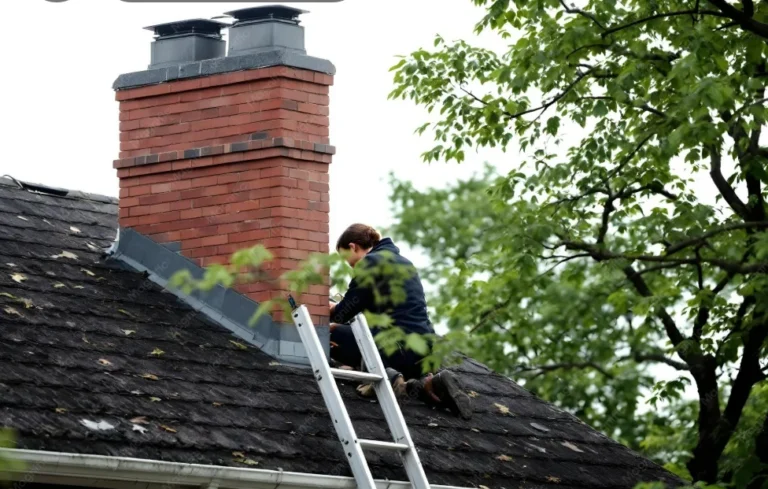
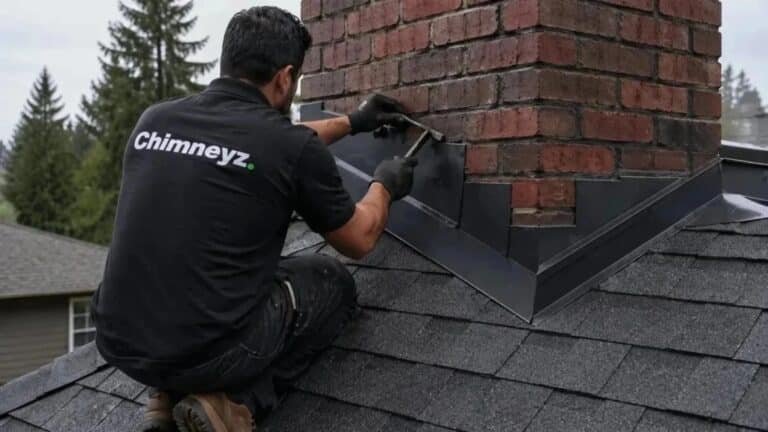
Flashing is the metalwork that seals the join between a rigid masonry stack and a roof that moves. Done properly it is two separate layers: step flashing woven into the roof courses as they are laid, and counter-flashing let into a groove cut in the mortar joint and lapped down over the top of it. Nothing in that assembly depends on sealant to keep water out; the geometry does the work and the sealant only closes the last gap.
What fails is almost always a shortcut on that. A single piece of metal caulked to the face of the brick, a previous leak patched with roofing tar, or counter-flashing that was never cut into the joint at all. All three look fine from the ground and all three put water straight onto the roof deck, which is why the signs below are worth checking from the attic as well as from outside.
What to look for
The cause
Done properly, flashing is two layers: step flashing woven into the roof courses, and counter-flashing let into a cut groove in the mortar joint and lapped over the top. A single piece of metal caulked to the brick is a common shortcut and it fails, because caulk is the only thing holding the water out.
Every sealed joint has a service life. Sun, heat and the constant small movement between roof and chimney dry it out, it shrinks away from one of the two surfaces, and the gap it leaves is directly above the roof deck.
Roofing cement is a tempting fix because it goes on fast and looks solid. It is also rigid once cured, so the next season of movement cracks it, and it is opaque, so the crack is invisible from the ground. Most of the badly rotted roof decks we open up have tar on the flashing above them.
Priority
Urgent. Flashing failure puts water directly onto the roof deck and the framing around the chimney, which is structural timber in a cavity that cannot dry. The repair is contained and straightforward while it is still a flashing job. Once the sheathing and rafters are involved it becomes carpentry, and once it reaches the ceiling below it becomes drywall and finishes as well.
Check it yourself
Six questions, no contact details, nothing sent anywhere. It tells you what the repair most likely involves and how soon it wants doing.
The repair
The join is opened up and inspected properly, including the condition of the roof deck underneath — a reseal over wet sheathing is a repair with a very short life.
Failed metal is replaced with stepped flashing woven into the roof courses and counter-flashing let into the mortar joint, not surface-caulked to the brick.
The mortar joint the counter-flashing sits in is cut and repointed so the metal is held mechanically, not stuck on.
Any damaged decking or framing found underneath is repaired as part of the same job, so the new flashing goes onto sound material.
The services this involves
If you wait
Flashing is the fastest-moving item on this list. Unlike masonry, which degrades over seasons, a failed flashing detail delivers water onto bare wood every time it rains. Roof sheathing that stays wet delaminates, rafter ends soften, and the damage spreads outward from the chimney in both directions. What makes it expensive is not the flashing — it is everything that has to be cut out and replaced before new flashing can be installed on something solid.
Right now
Lifted metal, a dried-out seal or a tar patch. Reflashed and repointed properly, this is a day on the roof.
Through the next wet season
Water lands on bare sheathing every time it rains. The deck delaminates and the rafter ends soften in a place nobody can see.
A few years on
Decking, framing, insulation and the ceiling below all have to be made good before new flashing can be fixed to anything solid.
Questions
If the metal is sound, correctly stepped and counter-flashed, and only the sealant has failed, then yes — cleaning out the joint and resealing it is a legitimate repair. If the metal is rusted, lifting, or was never properly let into the mortar joint, resealing it only buys a season.
Roofing tar cures rigid, and the join between a chimney and a roof never stops moving. The tar cracks, the crack is hidden under a black surface, and water runs through it. It also has to be removed before a proper repair can be made, which is why a tar patch usually costs you twice.
You need whoever will take responsibility for both sides of the join, which is exactly where this repair usually goes wrong — the roofer points at the masonry and the mason points at the roof. We do the chimney, the flashing and the roof, so the join is one trade’s problem.
It stops the cause. The stain itself, and any damaged drywall, insulation or framing behind it, is a separate piece of work — one we can handle in the same job, but it should be priced and done after the leak is sealed, not before.
Keep looking
Dark staining, mold or soft, rotting framing means water is already getting in — usually from failed flashing or a cracked crown above.
Read the signWatchWhen brick faces flake and mortar turns to sand, your masonry’s first line of defense against water has failed and needs repair.
Read the signWatchThat powdery white film is salt left behind as water passes through the brick — a clear sign moisture is moving through the masonry.
Read the signUrgentThe concrete cap that sheds rain has split. Water now runs straight into the flue and the masonry below every time it rains.
Read the signUrgentA chimney pulling away from the house, or one shedding brick and mortar, points to structural failure that only gets worse and costlier.
Read the signNext step
We will tell you what it is and what it needs, including when the answer is that it can wait. Serving Seattle and the surrounding Puget Sound area.
 CALL NOW