4 min read
Does moss actually damage a roof, or is it just ugly?
It damages the roof. Moss holds many times its own weight in water directly against the roofing surface, so the deck below never gets a chance to dry. On shingles its rhizoids work under the edges and lift them, breaking the water seal. On metal the trapped moisture attacks the protective coating and starts corrosion at the seams. Growth is a maintenance issue; ignoring it becomes a replacement.
A green roof reads as charming in a region full of evergreens. Nowhere in North America grows roof moss as enthusiastically as western Washington, and most homeowners here treat it as part of the scenery.
It is not cosmetic. Moss changes how a roof handles water, and a roof that cannot shed water has a limited life.
Lichen and algae are frequently lumped in with moss and behave differently. Algae leaves the dark vertical streaking seen on so many roofs here and is largely cosmetic. Lichen bonds chemically to the shingle surface and takes granules with it when removed. Moss is the one that lifts material and holds water, which is why it is the one that shortens a the life of a roof.
Moss Is a Sponge Held Against Your Roof
A moss mat holds a remarkable amount of water relative to its size and releases it slowly. On a roof, that means the surface underneath stays wet long after the rain has stopped, through the stretches of grey weather that define the local autumn.
Roofing materials are engineered to get wet and then dry. They are not engineered to stay wet. Permanent dampness is what drives the rest of the damage below.
The weight is worth a thought on older roofs. A saturated moss mat across a large north slope adds a real and permanent load to a structure that was designed for intermittent rain and occasional snow, not for a sponge that never empties. On a roof already carrying two or three layers of old shingles, that extra dead load is not trivial.
What It Does to Asphalt Shingles
Moss does not have roots in the ordinary sense, but it anchors with fine structures called rhizoids that work into any available gap. On a shingle roof the available gap is the lower edge of each course.
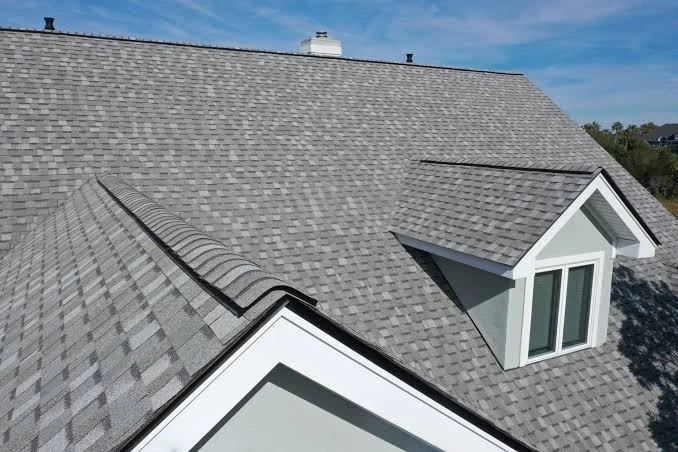
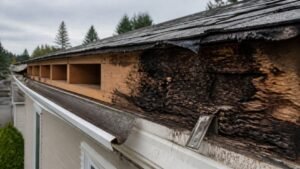
As the mat thickens it exerts steady upward pressure, lifting the shingle edge away from the one below. Once lifted, the course no longer forms a continuous water barrier, and wind-driven rain gets underneath. The granules that protect the asphalt from ultraviolet light also come away with the moss when it is pulled off badly, which is why aggressive scraping often does more harm than the moss did.
Moss also changes how debris behaves. A clean roof sheds fir needles and leaves; a mossy one catches and holds them. That trapped organic matter decomposes, holds its own water, and feeds the next generation of growth, which is why a roof that has been mossy for a few years gets worse much faster than one that is just starting.
What It Does to Metal Roofing
Metal roofs are often sold as moss-proof. They are moss-resistant, which is not the same thing. Moss struggles to establish on a clean, steep metal panel, but it will take hold readily in the places that stay damp and shaded: valleys, north-facing slopes, the low edge of a shallow pitch, and anywhere debris collects.
Once established it holds moisture directly against the protective coating. The coating is the only thing standing between the steel and corrosion, and constant wetness combined with the mildly acidic conditions under a moss mat wears it through. Corrosion then starts where it is hardest to see, at the seams and fasteners.
Zinc or copper strips installed at the ridge are the standard preventive measure here, and they work on the same principle as the small amount of metal already present around a chimney or a vent: rain picks up trace metal ions as it passes and inhibits growth on everything downslope. It is worth noticing that the clean streaks on a mossy roof usually run directly below the flashings.
The Places Moss Does the Most Damage
Moss concentrates where water already lingers, which is also where a roof is already most vulnerable:
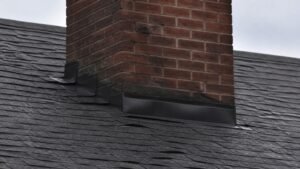
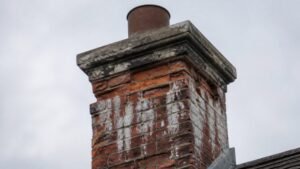
- Against the chimney, where the flashing joint depends on a clean, dry seal.
- In valleys, which carry the highest water volume on the entire roof.
- Along the eaves, where a moss dam can hold water back into the gutter line.
That first one matters more than it looks. Moss packed against the base of a chimney keeps the flashing permanently wet, and failing flashing is one of the most common causes of interior water damage we are called out to. If the moss has been there for years, the question is usually whether the roof needs targeted repair or a full replacement.
Timing the work matters in this climate. Moss treatment is most effective applied to growth that is actively growing but not soaking wet, which in practice means late spring or early autumn rather than the middle of a wet winter. Scheduling it alongside gutter clearing avoids paying twice for the same access.
Get Ahead of It with Chimneyz LLC
Moss removal done correctly is gentle, deliberate, and followed by work that stops it coming straight back. Done wrong, with a pressure washer and a stiff brush, it strips a roof of years of service life in an afternoon.
Chimneyz LLC assesses the roof and the chimney junction together, because in this climate they fail together. Get in touch and we will tell you whether you are looking at maintenance or at something that has already gone further.