4 min read
Why do crawl spaces rot so badly in western Washington?
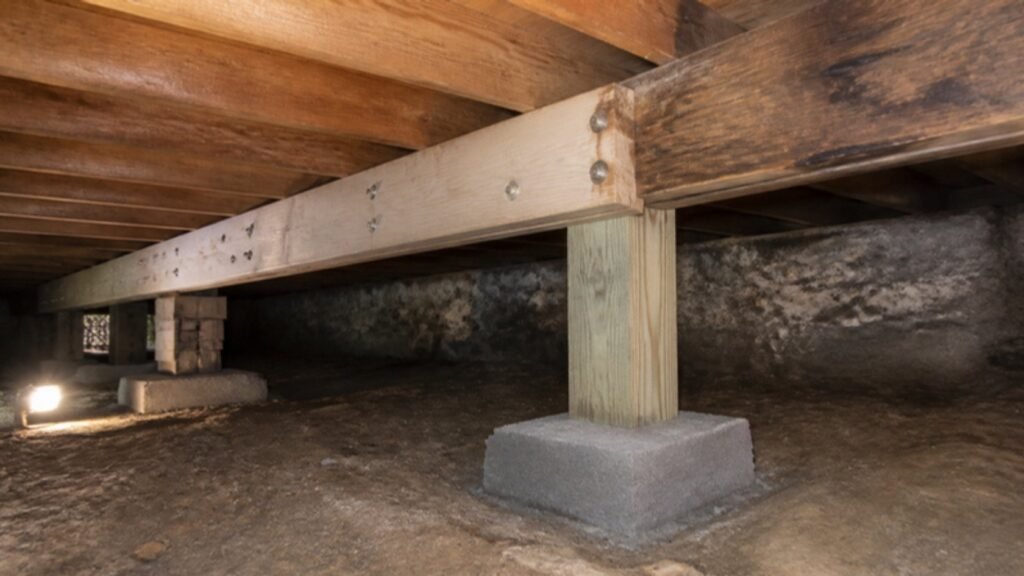
Because the soil under the house stays wet year round and the air above it rarely gets a chance to dry. Vented crawl spaces make this worse in summer, when warm humid outside air enters and condenses on cool framing and ducts. The result is months of surface moisture on wood that never fully dries, which is exactly the condition rot fungus needs. Controlling the ground moisture is what breaks the cycle.
Crawl spaces fail here in a way they do not in most of the country, and it is not because the houses were built badly. It is because the standard crawl space design assumes a climate western Washington does not have.
Understanding the mechanism makes the fix obvious, and it is not the one most homeowners expect.
Grading and drainage outside set the baseline. Downspouts discharging at the foundation, ground sloping back toward the house, or a patio that has settled against the wall all raise the moisture level under the building before the crawl space design gets a chance to matter. The cheapest crawl space improvement is frequently made outside it.
The Ground Is the Water Source
Most of the moisture in a crawl space does not come from a leak. It evaporates up out of the soil, continuously, in quantities that surprise people the first time they see the numbers. In a region with a high water table and months of saturating rain, that evaporation never pauses.
Bare earth under a house is therefore a permanent humidifier pointed at the floor framing. Everything else follows from that.
Winter reverses the flow without improving matters. Cold outside air entering the vents is dry in absolute terms, but it chills the floor structure above, which pulls warm moist air down out of the house through every gap in the subfloor. The crawl space becomes a condensing surface for the home it is supposed to support.
Why the Vents Make It Worse
Foundation vents exist on the theory that outside air will carry the moisture away. That works in a dry climate. In this one it reverses for much of the year.
On a warm summer day, outside air holds a great deal of moisture. It enters the crawl space and meets framing, ducts and pipes that are still at ground temperature, well below the dew point of that incoming air. The moisture condenses out onto those cool surfaces. The vent that was supposed to dry the crawl space is actively wetting it.
Ductwork is a frequent accelerant. Air conditioning or heat-pump ducts running through a humid crawl space sit well below the dew point of the surrounding air in summer, so they sweat continuously and drip onto the ground and the framing directly beneath them. The wettest joists in a crawl space are very often the ones under a duct run.
What Rot Actually Needs
Wood-destroying fungus needs a narrow set of conditions, and a Puget Sound crawl space supplies all of them at once:
- Sustained wood moisture content above roughly twenty percent.
- Mild temperatures, which this region has in abundance.
- Still air and darkness, which every crawl space has by definition.
Nothing dramatic is required. No flood, no burst pipe. Just a floor structure sitting a few percentage points too damp for several years running, which is why the damage is usually extensive by the time anyone notices a soft floor or a musty smell upstairs.
The consequences reach beyond the structure. Air in a house moves upward, which means a meaningful share of what you breathe on the ground floor entered through the crawl space first. Musty smells, allergy symptoms that worsen indoors, and persistently high humidity upstairs are all commonly traced to the space underneath.
What Actually Stops It
The fix is to separate the house from the ground rather than to ventilate harder. A sealed vapour barrier across the soil, the walls insulated, the vents closed and the space brought inside the building envelope removes the water source instead of chasing it.
That is crawl space encapsulation. Where water is also entering from outside, it needs waterproofing or a french drain first, because sealing a crawl space that still takes on groundwater just traps it. And where the framing has already gone soft, structural repair comes before any of it.
If you want one number before calling anyone, a cheap hygrometer left in the crawl space for a week will give it to you. Sustained relative humidity above about sixty percent means conditions are already in the range where rot fungus establishes, whatever the wood looks like today.
Look Under the House with Chimneyz LLC
A crawl space is the easiest part of a house to ignore and one of the most expensive to neglect, because the damage is to the structure the rest of the house sits on.
Chimneyz LLC inspects crawl spaces across the Puget Sound region and will show you the moisture readings rather than just describing them. Get in touch to book a look underneath.