4 min read
Is white powder on my brick chimney dangerous?
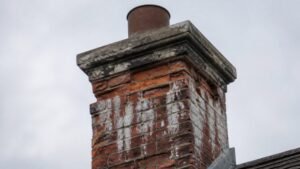
The powder itself is harmless. It is efflorescence: mineral salt left behind when water travels through the brick and evaporates at the surface. The danger is what it proves. Salt only reaches the outside if water is moving through the masonry, so a white bloom means the chimney is taking on moisture faster than it can shed it. Treat it as a moisture reading, not a stain.
A chalky white bloom spreading across a brick chimney looks like a cleaning problem. Most homeowners reach for a brush, scrub it away, and consider the matter closed. It comes back, usually after the first long stretch of Puget Sound rain, and it comes back a little wider than before.
That cycle is the important part. The powder is efflorescence, and scrubbing it off treats the symptom while the cause keeps running.
Worth saying plainly at the outset: the deposit is not mould, it is not a health hazard, and nothing about it is urgent on its own. Homeowners often arrive at the opposite conclusion because white growth on a wall usually is a problem. Here the material is inert. What it carries is information.
What Efflorescence Actually Is
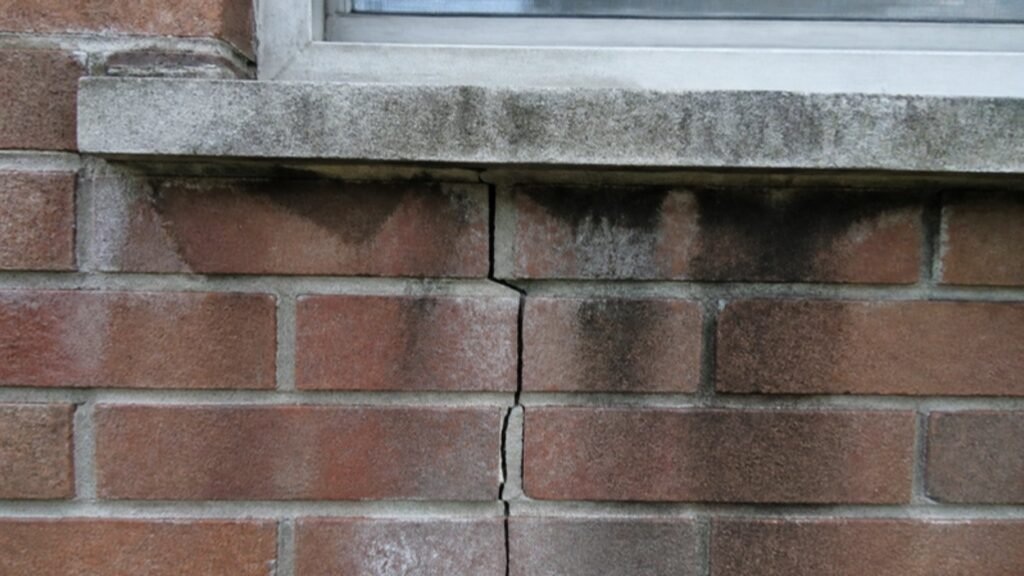
Brick and mortar both contain soluble mineral salts. When water enters the masonry, it dissolves those salts and carries them along as it travels. At the outer face of the chimney the water evaporates into the air, but the salt cannot evaporate. It is left sitting on the surface as a fine white crystalline deposit.
So the powder is not something that landed on your chimney. It came out of it. Every visible bloom is physical proof that water completed a journey from inside the masonry to the outside face.
There is a useful distinction between efflorescence and the harder, duller deposit sometimes called lime run. Efflorescence brushes off dry and returns; lime run is calcium carbonate that has set hard and usually traces back to water passing through fresh concrete, typically a recent crown pour. If the deposit resists a dry brush, the water is coming from a different place than most homeowners assume.
Why It Matters More in the Puget Sound
Western Washington gives masonry the two conditions it likes least: long soaking periods followed by cold nights. A chimney here can stay damp for weeks at a time between October and April, which means the salt transport never really stops.
Worse, saturated masonry is vulnerable to freeze-thaw. Water trapped in the brick expands as it freezes, pushing microscopic fractures a little wider each cycle. In the Cascade foothills, where overnight temperatures cross freezing far more often than they do at sea level, this is the mechanism that turns a damp chimney into a crumbling one.
Position on the stack is informative too. A bloom concentrated in the few courses just below the crown points upward, to the top of the chimney. A bloom that starts at the roofline and spreads downward points at the flashing. One that appears on the interior face, in an upstairs room or in the attic, means water has already crossed the full thickness of the masonry, and that is no longer an early warning.
What the Water Is Getting In Through
Efflorescence tells you water is entering, but not where. In practice it is almost always one of a short list:
- A cracked or undersized crown, which should shed water away from the brick but instead funnels it in.
- Open mortar joints, where decades of weather have eroded the mortar back behind the face of the brick.
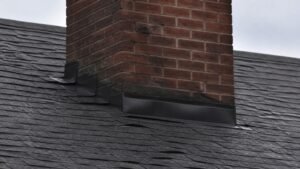
- Failed flashing at the roofline, letting water run down the outside of the chimney and soak in at the base.
Each of these has a different fix. A crown repair addresses the top, tuckpointing rebuilds the joints, and flashing work handles the roof junction. Guessing between them wastes money, which is why the first step is always finding the entry point rather than sealing the surface.
Timing matters as well as location. Efflorescence that appears within the first year of new masonry is often just the mix drying out and will stop on its own. A bloom that appears on a chimney that has stood for thirty years without one is a change in behaviour, and changes in behaviour are what deserve attention.
Why Sealing It In Makes Things Worse
The instinct to apply a waterproof sealer over the whole chimney is understandable and usually damaging. A non-breathable sealer does not stop water that is already entering from the crown or the joints. What it does is trap that water inside the masonry, where it has nowhere to evaporate.
The result is accelerated spalling: the brick face pops off in flakes because the pressure has to go somewhere. If you are already seeing brick that is crumbling or flaking alongside the white bloom, the chimney has moved past the warning stage.
If you want to monitor it yourself before calling anyone, photograph the affected face from the same spot once a month through the winter. A bloom that holds roughly steady is a slow leak. One that widens measurably between October and February is an active one, and the difference tells a contractor a great deal before they even arrive.
Read the Chimney with Chimneyz LLC
White powder is one of the few symptoms that gives you warning before real damage starts. Acting while it is still just a stain is far cheaper than acting after the brick face has begun to fail.
Chimneyz LLC works across King, Pierce, Snohomish and the surrounding counties, and we start by finding where the water is entering rather than by sealing what you can see. Book an inspection and we will tell you which of the three causes is yours.